Is the 3 AM “shoulder throb” making your bedroom feel more like a recovery ward than a place of rest? You’ve tried every pillow and ice pack, yet a sharp, electric spasm jolts you awake just as you finally drift off. This isn’t just a lack of sleep; it’s a cycle of exhaustion that stalls your body’s ability to heal. You aren’t looking for a “quick fix”—you’re looking to break a neurological grip.
SIGMA Orthopedics integrates Flexeril for rotator cuff pain as a tactical skeletal muscle relaxant designed to “quiet” the central nervous system and break the Spasm-Pain Cycle. This short-term tool facilitates restorative sleep, allowing your body to stabilize before transitioning to topical anti-inflammatories and data-driven physical therapy. Our goal is to move beyond masking symptoms to achieving measurable functional recovery.
Is Flexeril an NSAID? Understanding the Mechanism
The short answer is no. While both are used for pain, they belong to entirely different “toolkits” in the SIGMA recovery system.
To understand why this matters for your rotator cuff, you have to look at where these medications actually work:
NSAIDs (Ibuprofen, Naproxen, Aleve)
- The Target: The “Biochemical Soup” at the injury site.
- The Action: They “cool down” the physical heat, redness, and swelling in the tendon itself.
- The Goal: To stop the local chemical reaction of inflammation.
Flexeril (Cyclobenzaprine)
- The Target: The Central Nervous System (Brain and Spinal Cord)..
- The Action: It acts as a “volume knob” for your nerves. It tells the brain to stop sending “emergency” signals to the muscles surrounding your shoulder.
- The Goal: To break the muscle guarding reflex that causes painful spasms.
Key Differences at a Glance
| Feature | NSAIDs (Advil/Aleve) | Flexeril (Cyclobenzaprine) |
| Drug Class | Non-Steroidal Anti-Inflammatory | Skeletal Muscle Relaxant |
| Primary Job | Reduces swelling & heat | Stops muscle spasms & guarding |
| How it feels | Localized relief | Systematic relaxation (may cause “fog”) |
| Best used for | Tendonitis & joint inflammation | 3 AM spasms & “locking” sensations |
Does Flexeril Help With Inflammation?
Because Flexeril is not an NSAID, it is not an anti-inflammatory. It won’t shrink a swollen bursa or a thickened tendon.
However, we often use it because inflammation and spasms are a “vicious cycle”:
- Inflammation causes pain.
- Pain causes the muscle to seize up (guarding).
- Seizing cuts off blood flow, which prevents the inflammation from clearing out.
By using a muscle relaxant medicine, we “quiet the alarm,” allowing blood flow to return and the healing process to actually begin.
The Science of the “Spasm-Pain Cycle”

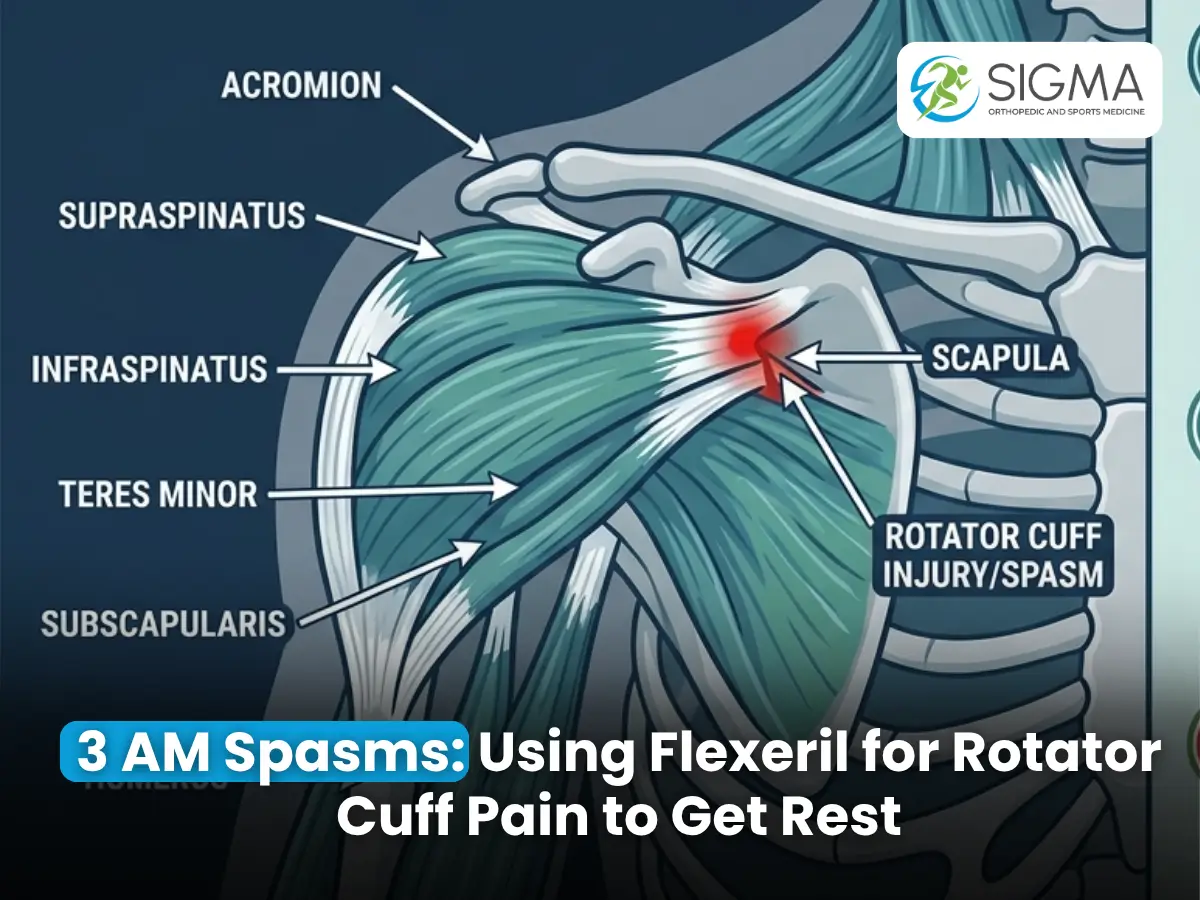
If you’ve ever felt like your shoulder is “locking up,” you aren’t imagining it. When you suffer a rotator cuff injury, your brain enters a protective mode called muscle guarding.
It’s an ancient survival mechanism. Your brain perceives the tear as a structural threat. It sends an emergency signal to the surrounding muscles—the traps, the deltoids, and the neck—to seize up and create a biological “splint.”
This is why cyclobenzaprine for shoulder pain is so frequently discussed in orthopedic circles. The pain isn’t just coming from the tendon; it’s coming from the muscles that are working overtime to protect that tendon.
However, this “splint” eventually becomes the problem.
- Constant contraction leads to a lack of blood flow.
- Lack of blood flow leads to more pain.
- More pain leads to more seizing.
This is the Spasm-Pain Cycle. While we often see this in the shoulder, the same logic applies to using Flexeril for knee pain or even Flexeril for neck and shoulder pain. Whether it’s a joint in your leg or your rotator cuff, the brain’s “panic button” works the same way.
The SIGMA Perspective: Is Flexeril for Arthritis Pain Different?
When considering Flexeril for arthritis pain, it is essential to manage expectations. Arthritis is fundamentally a structural issue, while Flexeril is a neurological tool.
Here is how to look at the difference:
- The Reality of Arthritis: This is a “bone-on-bone” or cartilage degradation issue. Flexeril will not grow back cartilage or repair the joint surface.
- The “Referred Stiffness” Factor: Osteoarthritis often causes you to move with a “guarded” posture. To protect the aching joint, your brain over-activates the surrounding muscles.
- Secondary Muscle Exhaustion: Because these muscles are constantly “on,” they become fatigued, leading to the deep, localized aches people often mistake for the joint itself.
How Flexeril Helps (The “Window of Relief”)
Instead of treating the arthritis directly, cyclobenzaprine for knee pain or shoulder stiffness treats your body’s reaction to the arthritis.
- Quiet the Alarm: It relaxes the “guarding” muscles that have seized up around the arthritic joint.
- Restore Range of Motion: By reducing stiffness, it opens a “window” where you can actually move the joint.
- Enable Physical Therapy: This window is critical. It allows you to perform the strengthening exercises necessary to support the joint, something that is nearly impossible when your muscles are locked in a spasm.
Summary: Arthritis vs. Muscle Spasms
| Condition | Primary Issue | Does Flexeril Help? |
| Osteoarthritis | Cartilage wear / Bone friction | No (Structural) |
| Muscle Guarding | Muscles seize to protect the joint | Yes (Neurological) |
| Referred Stiffness | Tightness in areas around the joint | Yes (Functional) |
Note: We use Flexeril for arthritis pain as a support tool, not a cure. It clears the path so that high-performance treatments, like physical therapy or orthobiologics, can do their work.
Topical Anti-Inflammatories vs. Oral Muscle Relaxants
If you are hesitant about the “head fog” that sometimes comes with oral pills, you might be looking for a topical anti-inflammatory. There is a massive difference in how these two interact with your injury:
- The Topical Approach: Creams or gels (like Diclofenac) penetrate the skin to reduce localized swelling. This is often the best anti-inflammatory for tendonitis because it goes straight to the source without affecting your entire system.
- The Systemic Approach: Muscle relaxant medicine like Flexeril travels through your bloodstream to the central nervous system.
In a high-performance recovery plan, we often use both. We use the topical to “cool the fire” of the tendon and the Flexeril to “quiet the alarm” in the brain.
The SIGMA Roadmap: Moving from Medication to Mobility
Taking Flexeril for rotator cuff pain is a tactical move, not a long-term strategy. To get back to full function, you need a coordinated plan. At SIGMA, we break this down into four precision phases.
Phase 1: Quelling the “System Alarm”
In the first 48 to 72 hours of an acute injury, your body is in high-alert mode.
- The Goal: Reduce the neurological “guarding” that prevents movement.
- The Tool: This is where cyclobenzaprine for shoulder pain shines.
- The Key: Use it at night to ensure the 3 AM spasms don’t interrupt the body’s natural repair cycle.
Phase 2: Identifying the True Pain Generator
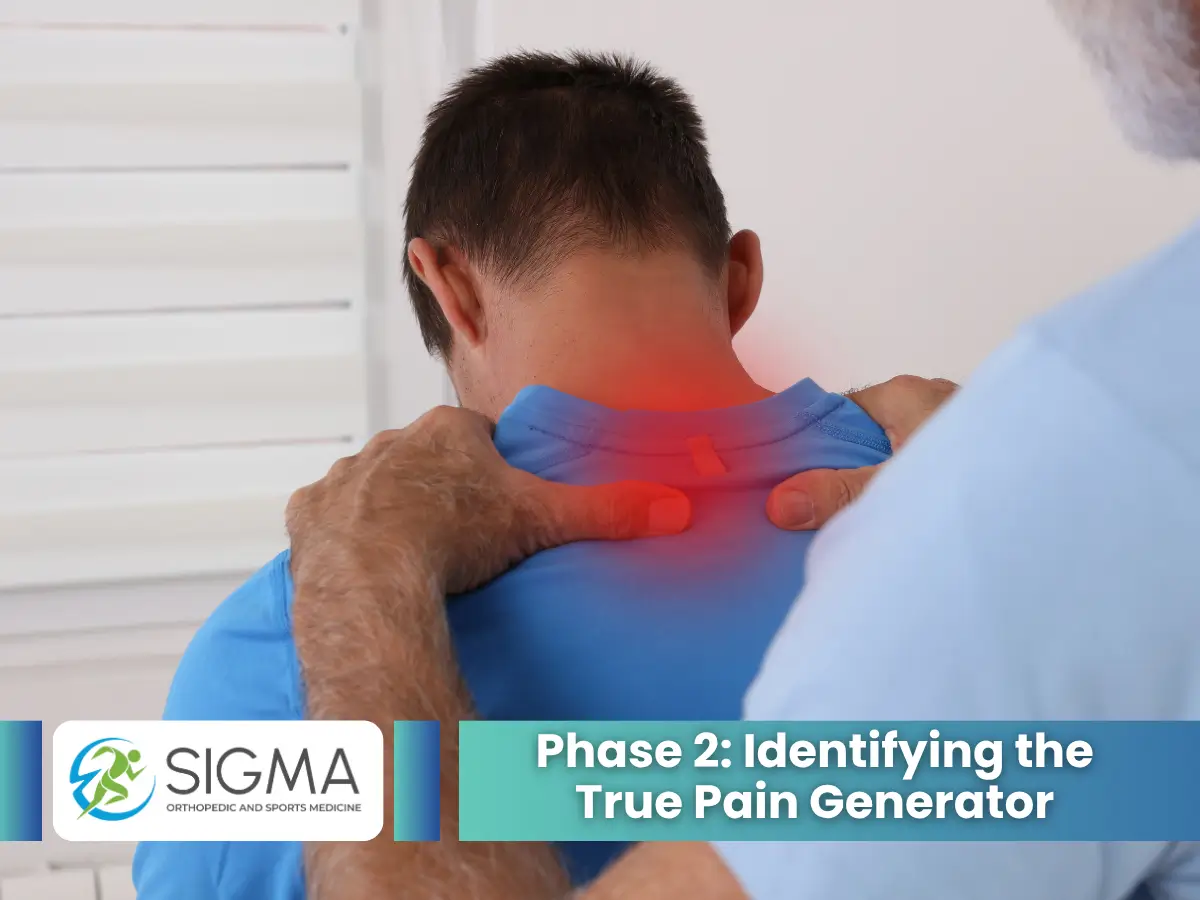
Not all shoulder pain is created equal. If the medication isn’t working, we shift our focus.
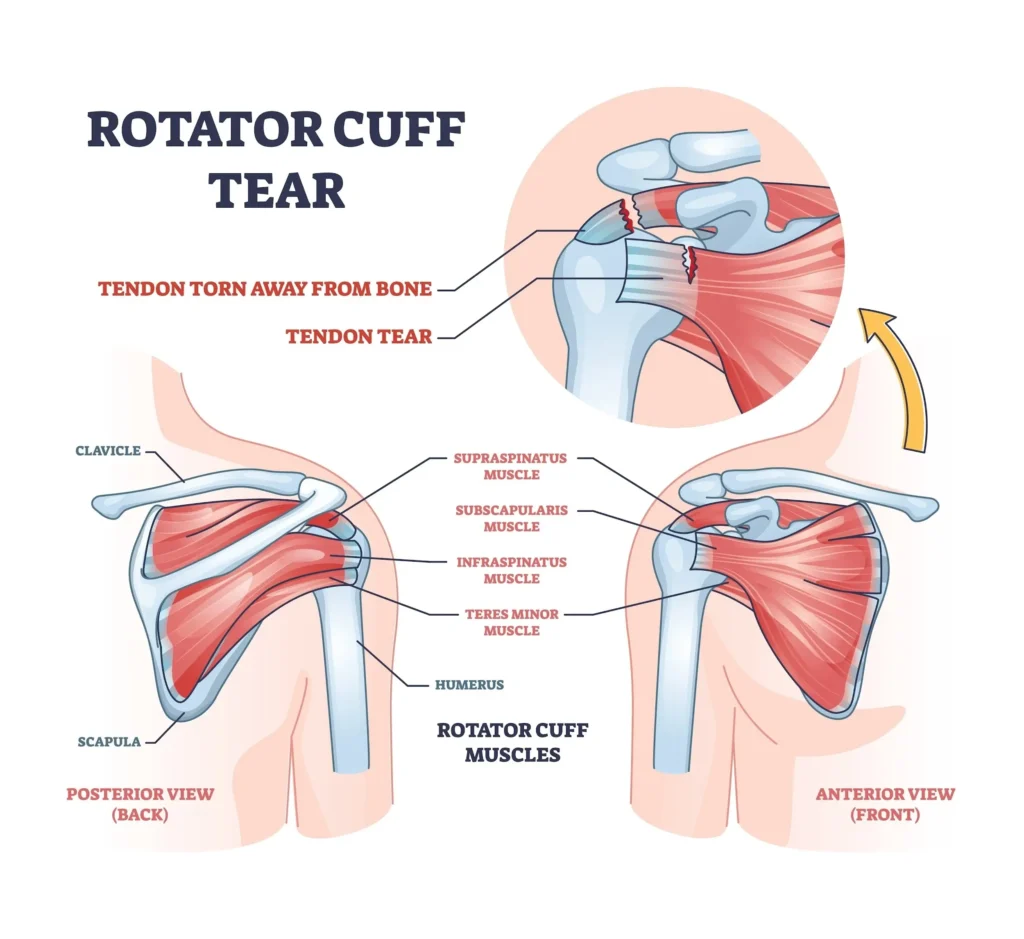
- The Question: Is this Flexeril for tendonitis (inflammation) or a mechanical tear?
- The Test: If a muscle relaxant medicine provides zero relief, it’s a signal that the issue is structural, not just muscular.
- The Precision Move: This is when we utilize advanced imaging to see exactly what is happening inside the joint.
Phase 3: The Multi-Modal Transition
As the acute spasms fade, we phase out the systemic drugs and move toward localized care.
- Topical Support: Switching to a topical anti-inflammatory allows you to treat the joint without the “head fog.”
- Inflammation Control: This is the time to identify the best medicine for muscle pain for your specific biology.
Phase 4: Functional Loading
The final step isn’t just “feeling better”—it’s being stronger.
- Rehab: We use the comfort provided by medication to start physical therapy.
- The Goal: Training the rotator cuff to fire correctly so the “guarding” never comes back.
Safety Checklist: Using Flexeril Responsibly
If your specialist has determined that Flexeril for rotator cuff pain is right for you, follow these “Six Sigma” guidelines for safety:
- Test at Night First: Because it can cause significant drowsiness, never take your first dose before driving or operating machinery.
- Avoid the “PT Mask”: Do not take Flexeril immediately before a physical therapy session. You need to be able to “feel” your limits to avoid re-injury.
- Watch the Alcohol: Mixing muscle relaxants with alcohol creates a dangerous sedative effect.
- Hydrate: These medications can cause dry mouth and dehydration, which actually makes muscle cramps worse.
- Short-Term Only: These are bridges, not permanent fixes. Most protocols limit use to 2–3 weeks.
The Expert Review: Does it Really Work?

So, is Flexeril for rotator cuff pain effective? The answer depends on your goal.
If your goal is to “heal the tear,” the answer is no. If your goal is to stop the agonizing spasms so you can sleep and participate in rehab, the answer is a resounding yes.
At SIGMA Orthopedics, we don’t believe in “shotgun” medicine where you throw a pill at a problem and hope it sticks. We believe in precision. We use medicine for muscle pain to create the optimal environment for your body to heal itself.
Whether you are dealing with Flexeril for knee pain, shoulder issues, or chronic neck tension, the strategy remains the same:
- Diagnose the source.
- Stabilize the symptoms.
- Strengthen the structure.
Ready for Clarity?
Don’t spend another night at 3 AM wondering if your pain is getting worse. If you are leaning on Flexeril for rotator cuff pain but aren’t seeing a path to full recovery, it’s time for a second opinion.
At SIGMA Orthopedics, we provide the structured treatment roadmaps you need to get back to the activities you love.
Quick-Answers
Is Flexeril an NSAID?
No. Flexeril (Cyclobenzaprine) is a skeletal muscle relaxant. It belongs to a different class of drugs than NSAIDs like Advil or Aleve.
What is the best anti-inflammatory for tendonitis?
For localized tendon issues, a topical anti-inflammatory (like Voltaren) or a high-dosage NSAID is typically most effective.
Can I use Flexeril for shoulder pain and neck pain at the same time?
Yes. Because it works centrally in the brain, it can help relax multiple muscle groups simultaneously.
Is Flexeril an anti-inflammatory?
No, it does not have primary anti-inflammatory properties, though it may help improve circulation to inflamed areas.
Disclaimer: This content is for informational purposes only and does not constitute medical advice. Always seek the advice of a qualified healthcare provider with any questions you may have regarding a medical condition or before starting any new medication. Never disregard professional medical advice or delay in seeking it because of something you have read in this blog.