Are you struggling to get your medical claims approved for shoulder procedures? Coding for shoulder surgery is a total labyrinth. One wrong digit in an ICD-10 string can lead to a rejected claim, causing financial headaches and slowing down patient care. You’re busy, and the last thing you need is a pile of paperwork sent back for a simple mistake. When the right shoulder is involved, specificity is everything. Missing a “right-sided” indicator means the difference between a paid claim and a denied one.
At SIGMA Orthopedics, we believe precision shouldn’t stop at the operating table. Dr. Frank McCormick and our team use a data-driven system to ensure every right shoulder arthroscopy icd 10 code is pinpoint accurate. We focus on a high-standard, outcome-driven approach that gets you back to your life faster while reducing treatment uncertainty. Our goal is to make the complex simple.
Mastering Laterality and the 6th Character
The most fundamental rule of orthopedic coding is the law of laterality. In the ICD-10-CM system, the 6th character is almost always the “side” indicator.
- 1: Right
- 2: Left
- 3: Bilateral
- 9: Unspecified
For a right shoulder surgery, utilizing a code that ends in “9” is an invitation for an audit. Payers like Blue Cross Blue Shield and Medicare increasingly use automated “front-end” edits that instantly reject claims where the procedure code (CPT) indicates a right-side intervention, but the diagnosis code (ICD-10) is unspecified.
The “S” vs. “M” Distinction: Etiology Matters
Before choosing a code, the surgeon must determine the origin of the condition. This is where the SIGMA Approach to precision diagnosis becomes vital.
- M-Codes (Musculoskeletal): These are for chronic, degenerative, or non-traumatic conditions. If a patient has “wear and tear” from years of overhead athletics, you are in the M-category.
- S-Codes (Injury/Poisoning): These are for acute trauma. If a patient suffered a “right shoulder full-thickness tear” after a fall from a ladder, the claim must reflect an S-code to trigger the correct insurance liability (such as personal injury or workers’ compensation).
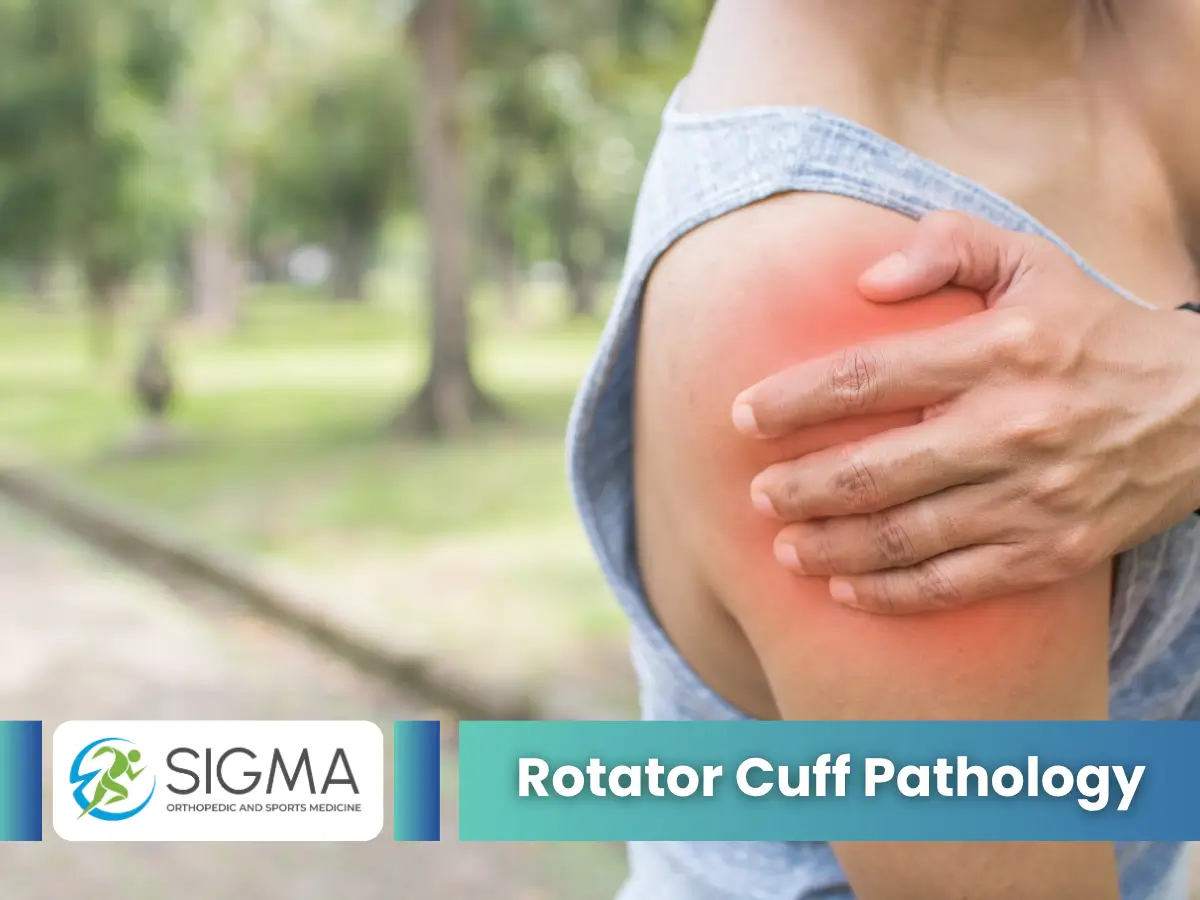
Rotator Cuff Pathology
1. Chronic and Degenerative Tears
When documenting a standard repair, the distinction between “complete” and “incomplete” is paramount.
- Right shoulder full-thickness tear (Non-traumatic): M75.121. This code specifies a complete rupture of the right rotator cuff.
- Incomplete/Partial Tear (Non-traumatic): M75.111.
2. The Recurrent Tear: A Higher Level of Complexity
A right shoulder recurrent rotator cuff tear is a different clinical entity from a primary tear. It implies scar tissue, altered anatomy, and often a more difficult surgical approach. While there is no single “recurrent” code, coding professionals recommend a dual-coding strategy:
- The primary tear code (e.g., M75.121).
- A status code indicating a history of rotator cuff repair (Z98.890).
This combination tells the payer’s medical director that the surgeon is performing a revision, which justifies higher-level CPT coding or increased intraoperative time.
Labral Tears and Biceps Pathology

A right shoulder arthroscopy often involves secondary repairs. To ensure maximum precision and avoid “unbundling” errors, use these specific ICD-10 codes:
SLAP Lesions (Superior Glenoid Labrum)
Documentation must distinguish between degenerative fraying and traumatic tears to justify surgical repair.
- Traumatic Tear: S43.431A (Superior glenoid labrum lesion of right shoulder, initial encounter).
- Chronic/Degenerative: M75.81 (Other shoulder lesions, right shoulder).
Biceps Tenodesis and Tenotomy
If the long head of the biceps (LHB) requires intervention alongside a right shoulder rotator cuff repair icd 10 claim, use:
- Inflammatory/Tenosynovitis: M77.11 (Bicipital tenosynovitis, right shoulder).
- Acute Strain/Tear: S46.111A (Strain of muscle and tendon of the long head of the biceps, right shoulder).
- Chronic Tendonitis: M75.21 (Bicipital tendinitis, right shoulder).
Coding for Arthrofibrosis and Adhesions
Arthrofibrosis is one of the most frustrating complications in orthopedics. When a patient returns for a “manipulation under anesthesia” (MUA) or an arthroscopic lysis of adhesions, the coding must be precise to avoid “Global Period” denials.
Arthrofibrosis of the right shoulder is often documented as:
- M25.611: Stiffness of right shoulder, not elsewhere classified.
- M24.611: Ankylosis, right shoulder.
If the stiffness is a result of a previous surgery, the documentation must reflect that the encounter is for a complication or a “planned staged procedure” to ensure payment during the 90-day global window. Refer to the AHIMA professional coding resources for their specific white papers on coding post-operative stiffness.
Arthroscopy vs. Arthroplasty: A Critical Distinction
In the administrative rush, it is easy for a biller to confuse right shoulder arthroscopy with right shoulder arthroplasty. However, these represent two entirely different “Service Pillars” within the SIGMA system.
Right Shoulder Arthroplasty (Joint Replacement)
If the patient has advanced bone-on-bone arthritis and requires a total shoulder or reverse total shoulder replacement:
- M19.011: Primary osteoarthritis, right shoulder.
- Z96.611: Presence of right shoulder joint implant (used for follow-ups).
Right Shoulder Arthroscopy (The “Scope”)
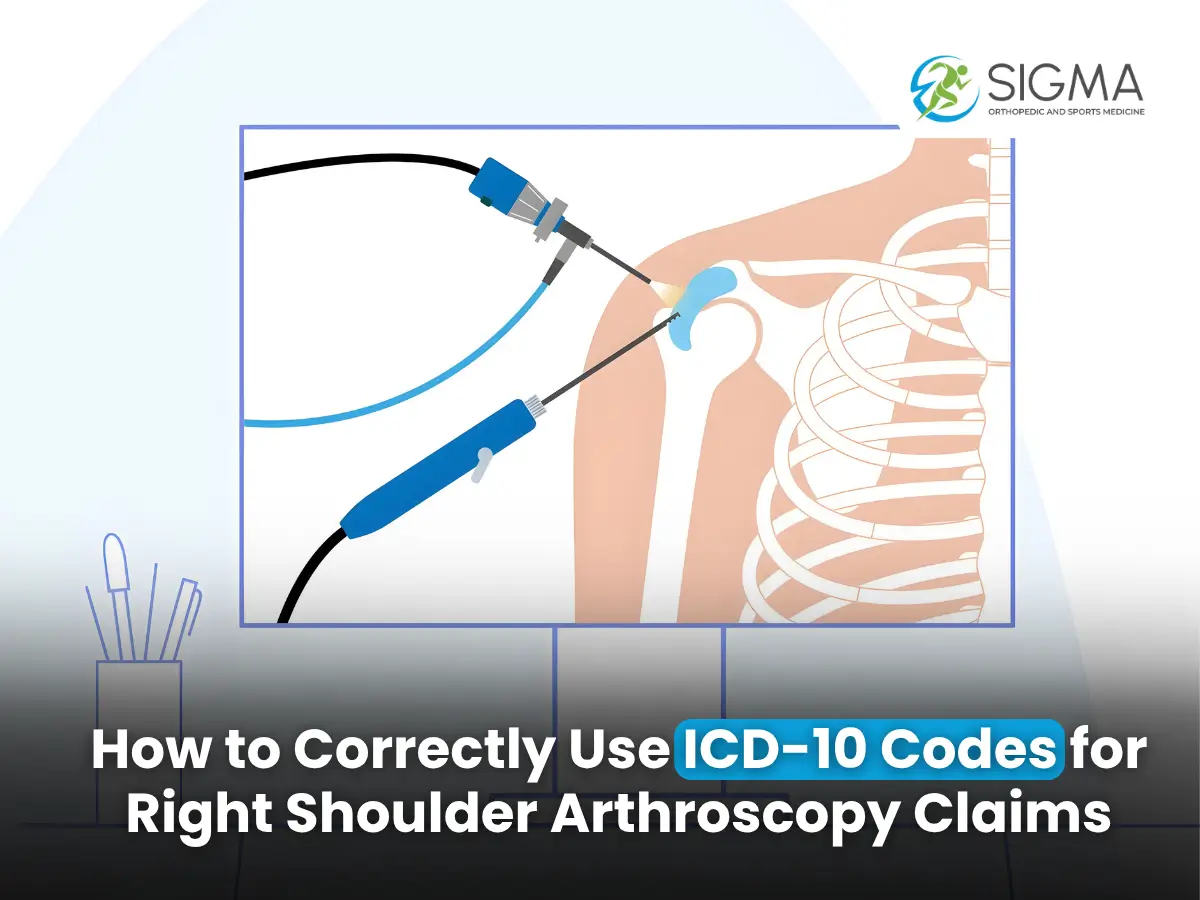
Arthroscopy is a surgical approach, not a diagnosis. The diagnosis codes used for arthroscopy are typically related to mechanical issues that can be fixed via a camera:
- M75.41: Impingement syndrome of the right shoulder.
- M75.81: Other shoulder lesions, right shoulder (often used for SLAP tears or bicipital tenosynovitis).
SIGMA Orthopedics: Right Shoulder Coding Reference Table
| Clinical Condition / Pathology | ICD-10-CM Code | Key Documentation Requirement |
| Complete Rotator Cuff Tear (Right) | M75.121 | Specify as full-thickness and non-traumatic. |
| Incomplete Rotator Cuff Tear (Right) | M75.111 | Specify as partial-thickness or fraying. |
| Traumatic Rotator Cuff Tear (Right) | S46.011A | Requires documentation of a specific injury/event. |
| Recurrent Rotator Cuff Tear (Right) | M75.121 + Z98.890 | Use primary tear code + “History of Repair” code. |
| History of Rotator Cuff Repair | Z98.890 | Essential for secondary/follow-up procedures. |
| SLAP Lesion / Labral Tear (Right) | S43.431A | Document “Initial Encounter” for acute repairs. |
| Bicipital Tenosynovitis (Right) | M77.11 | Supports Biceps Tenodesis (CPT 29828). |
| Arthrofibrosis / Stiffness (Right) | M25.611 | Document loss of Range of Motion (ROM). |
| Ankylosis / Severe Fibrosis (Right) | M24.611 | For severe “Frozen Shoulder” requiring MUA. |
| Impingement Syndrome (Right) | M75.41 | Supports Subacromial Decompression. |
| Primary Osteoarthritis (Right) | M19.011 | Primary code for Right Shoulder Arthroplasty. |
| Presence of Shoulder Implant (Right) | Z96.611 | For post-op reviews of a replacement joint. |
The SIGMA Protocol for Operative Notes
To ensure a 1,600-word level of detail is reflected in your practice, your operative notes must be bulletproof. A “Precision-Driven” operative note should follow this structure:
1. The Pre-Operative “Why.”
Don’t just list the diagnosis. Explain the failure of conservative care.
- Example: “The patient failed 12 weeks of structured physical therapy and two subacromial injections. MRI confirms a right shoulder full-thickness tear of the supraspinatus.”
2. The Intra-Operative “What.”
Be specific about the “zones” of the shoulder.
- Bad Documentation: “I repaired the rotator cuff.”
- SIGMA Documentation: “Arthroscopic evaluation of the right shoulder revealed a 2cm full-thickness U-shaped tear of the supraspinatus. Debridement was performed, followed by a double-row repair using three 4.75mm SwiveLock anchors.”
3. The Evidence-Based “Outcome.”
Connect the surgery to the data. Mentioning the “Measured Outcomes” that SIGMA tracks (like the ASES score or DASH score) helps establish the medical necessity of the procedure for future audits according to CMS reimbursement standards.
Addressing Common Billing Denials
Even with precise coding, claims can fail. Here are the top three reasons for denials in right shoulder surgery and how to resolve them:
- The “Bundling” Trap: Many procedures are bundled by NCCI edits (e.g., debridement within a rotator cuff repair).
- Solution: Use Modifier 59 only if procedures occur in distinct areas, such as a separate biceps tenodesis.
- Medical Necessity for Orthobiologics: Payers often label SynerG Orthobiologics as “experimental.”
- Solution: Code the primary right shoulder surgery icd 10 accurately (M75.121). Ensure the ICD-10 reflects the underlying pathology, keeping supply codes separate from the surgical claim.
- Missing Post-Operative Diagnosis: Discrepancies between MRI suspicions and intra-operative findings lead to rejections.
- Solution: Update the final claim to reflect actual findings. If you discover arthrofibrosis of the right shoulder icd 10 during a repair, it must be included in the final diagnostic string.
Advanced Coding: SynerG Orthobiologics and Regenerative Tiers
At SIGMA, we integrate evidence-driven regenerative treatments into our structured care pathways. When performing a right shoulder arthroscopy, the addition of biologics (like PRP or Bone Marrow Aspirate Concentrate) requires specific documentation. While most payers still use “Unlisted” codes for the biologic itself, the right shoulder surgery icd 10 diagnosis must reflect the degenerative state (e.g., M19.011 or M75.111) that necessitates the biologic augmentation.
Conclusion
Precision in the operating room is wasted if it is translated into “unspecified” language in the billing office. By mastering the right shoulder arthroscopy icd 10 landscape, the SIGMA team ensures that every patient’s roadmap—from diagnosis to recovery—is documented with the same level of care that went into the surgery itself.
Remember: A clean claim is a reflection of a clean procedure. Let your data be as precise as your scalpel.
Achieve precision in your recovery. Let SIGMA Orthopedics guide your journey from diagnosis to elite performance with our standardized, data-driven protocols.
Schedule your consultation today and define your surgical outcome.
Frequently Asked Questions (FAQs)
1. What is the most specific ICD-10 code for a right shoulder rotator cuff repair?
For a chronic tear, use M75.121 (Complete) or M75.111 (Incomplete). Always ensure the 6th digit is “1” to denote the right side.
2. How do I code a “history of rotator cuff repair” if the patient has a new injury?
You should use the code for the new injury (e.g., S46.011A for a traumatic strain) and add Z98.890 as a secondary code to indicate the previous surgical history.
3. What is the code for right shoulder arthroplasty vs. arthroscopy?
Arthroplasty (replacement) often uses M19.011 (Osteoarthritis) as the driver. Arthroscopy (scope) usually uses codes for tears (M75.121) or impingement (M75.41).
4. How do I document arthrofibrosis of the right shoulder?
Use M25.611 for stiffness. If the stiffness is preventing the joint from moving entirely (ankylosis), use M24.611.
5. Why was my “right shoulder full-thickness tear” claim denied?
The most common reason is the lack of a “trauma” vs “degenerative” distinction. If the payer expects an ‘S’ code because of a reported accident, but you submitted an ‘M’ code, they may deny it pending more information.
Disclaimer: For educational use only. Coding accuracy is the provider’s responsibility based on the 2026 CMS guidelines and specific documentation. Always verify current ICD-10/CPT codes with a certified professional coder (CPC) or official regulatory sources.