
Pain that occurs when you bend or straighten your elbow is usually caused by irritation, inflammation, injury, or wear involving the tendons, joint, nerves, or surrounding tissues. Common causes include overuse injuries such as tennis or golfer’s elbow, bursitis, arthritis, nerve irritation, and injuries such as sprains or fractures.
The location and behavior of the pain can provide important clues. Pain on the outside of the elbow may point toward a tendon problem, while pain directly over the back of the elbow may involve the bursa. Deep pain, stiffness, swelling, numbness, or an inability to fully straighten the arm can suggest a different problem that deserves an orthopedic evaluation.
Why Does My Elbow Hurt When I Bend or Straighten It?
The elbow is more complicated than it looks. It connects three bones and relies on cartilage, ligaments, tendons, muscles, and nerves to move smoothly. When one of these structures becomes irritated or injured, movement can make the discomfort more noticeable.
For some people, the pain appears mainly when the elbow is fully bent. Others notice it most when trying to straighten the arm. You may also feel discomfort when lifting, gripping, pushing, pulling, or putting pressure on the back of the elbow.
That is why the exact location of the pain matters. Your symptoms, recent activities, previous injuries, age, and physical examination all help determine the most likely cause.
MedlinePlus: Elbow Pain and Injuries provides an overview of common causes, evaluation, and warning signs associated with elbow pain.
Common Causes of Elbow Pain With Movement
Tennis Elbow
Tennis elbow, medically called lateral epicondylitis, affects the tendons attached to the outside of the elbow. Despite its name, it is not limited to tennis players. Repetitive gripping, lifting, typing, using tools, racquet sports, and other activities can place repeated stress on these tendons.
Pain is usually felt on the outside of the elbow and may extend down the forearm. It can become worse when gripping an object, lifting something with the palm facing down, or repeatedly moving the wrist.
Tennis elbow often develops gradually rather than after one specific injury. If you notice tenderness around the outer elbow along with reduced grip strength, a tendon problem may be responsible.
Golfer’s Elbow
Golfer’s elbow affects the tendons on the inside of the elbow. Like tennis elbow, it can happen even if you have never played golf.
Activities involving repeated gripping, wrist bending, throwing, lifting, or pulling can irritate these tendons. The discomfort may stay near the inner elbow or travel down the forearm.
The pain can become more noticeable when you bend your wrist, grip something firmly, or repeatedly use your arm. Treatment usually begins with activity modification and rehabilitation rather than surgery.
Elbow Bursitis
If you have tenderness or swelling directly over the back of the elbow, bursitis is another possibility. The olecranon bursa is a small fluid-filled sac that helps reduce friction around the tip of the elbow.
Repeatedly leaning on your elbows, a direct blow, or prolonged pressure can irritate this area. Bursitis can cause swelling that is easy to see and may make the back of the elbow particularly sensitive.
If you have a tip of elbow pain when touched, especially when there is a noticeable soft or swollen area, bursitis should be considered. A warm, red, increasingly painful elbow may require prompt medical evaluation because infection can also cause swelling and tenderness.
Arthritis
Arthritis can affect the elbow and cause pain, stiffness, swelling, and reduced range of motion. Osteoarthritis may develop after years of joint stress or following an earlier injury, while inflammatory forms of arthritis can affect the joint in different ways.
People with arthritis may notice discomfort after periods of inactivity or during movement. Some describe grinding, catching, or stiffness when trying to fully bend or straighten the arm.
If both elbows hurt or your symptoms occur along with discomfort in other joints, your physician may consider arthritis or another inflammatory condition as part of the evaluation.
AAOS: Osteoarthritis of the Elbow explains how elbow arthritis can affect motion and the structures surrounding the joint.
Ulnar Nerve Irritation
The ulnar nerve passes behind the inside of your elbow. It is the nerve responsible for the familiar tingling sensation people call the “funny bone.”
When this nerve becomes irritated or compressed, you may experience pain around the inner elbow, tingling, numbness, or symptoms traveling into the ring and little fingers. Bending the elbow for long periods can sometimes aggravate these symptoms.
Nerve-related pain feels different from typical muscle soreness. If your elbow symptoms are accompanied by persistent tingling, numbness, weakness, or changes in hand function, an evaluation is important.
Sprain, Strain, or Other Injury
A sudden injury can damage the ligaments, muscles, tendons, or bones around the elbow. A fall, sports collision, awkward twist, or heavy lifting incident may result in a sprain or strain.
A more serious injury may involve a fracture, dislocation, or tendon tear. A popping sound, significant swelling, bruising, deformity, or immediate loss of function should not be ignored.
After an injury, pain with movement is common, but the severity and associated symptoms help determine whether you need imaging or urgent treatment.
What Does the Location of Your Elbow Pain Mean?
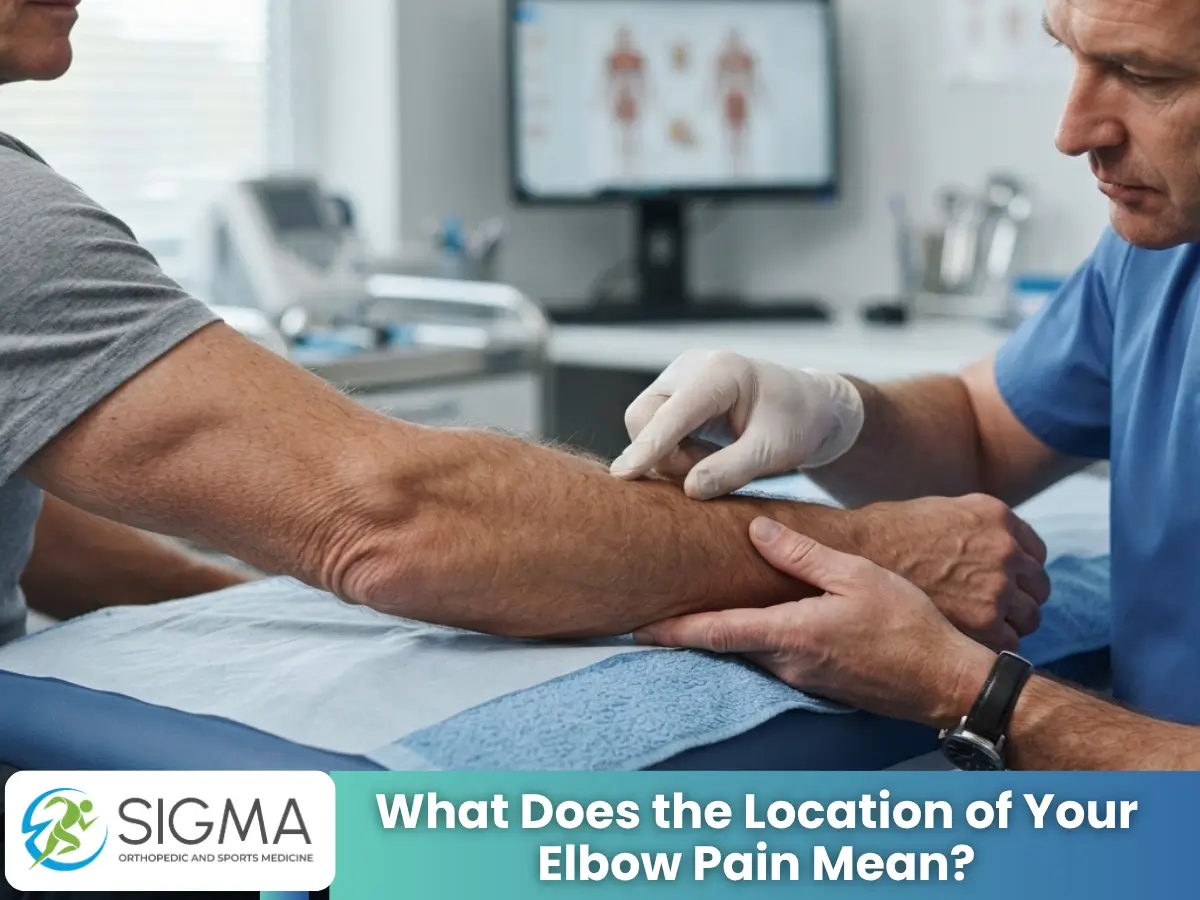
The location of your discomfort can help narrow down the possibilities, although it cannot provide a diagnosis by itself.
Pain on the outside of the elbow is commonly associated with lateral tendon irritation. Pain on the inside may involve the flexor tendons or ulnar nerve. Pain directly over the bony tip may be related to the olecranon bursa, particularly when swelling or tenderness is present.
Deep pain inside the joint can have several causes, including arthritis, cartilage problems, inflammation, or an injury involving structures within the elbow. Some people searching for “deep elbow fist” may actually be trying to describe a deep, hard-to-localize ache inside the joint rather than pain directly on the surface.
If the pain is difficult to pinpoint, becomes worse as you move through the full range of motion, or is associated with catching or locking, an orthopedic examination can help identify the source.
Why Does My Elbow Hurt When I Straighten My Arm?
If you are specifically wondering, “why does my elbow hurt when I straighten my arm,” the answer depends on where the pain occurs and what caused it.
Straightening the elbow places movement demands on the joint and surrounding soft tissues. If a tendon is irritated, extending the arm may reproduce the pain. A swollen bursa can also become uncomfortable as the joint moves.
A stiff or arthritic elbow may hurt near the end of extension because the joint has lost some of its normal mobility. In some cases, loose cartilage or bone fragments inside the joint can cause catching, locking, or a sensation that something is blocking movement.
Pain that consistently occurs at the same point during extension is worth discussing with an orthopedic specialist, especially if your range of motion is becoming more limited.
What If My Elbow Hurts When I Bend It?
Pain during bending can also have several explanations. Tendon irritation, bursitis, arthritis, nerve compression, and injury can all cause discomfort during flexion.
If the pain is on the back of the elbow, swelling or tenderness may point toward the bursa. If symptoms are on the inner side and travel toward the hand, nerve irritation may be involved. If the pain is on the outside and worsens with gripping, a tendon disorder may be more likely.
Your activity history is useful here. Someone who recently increased weight training may have a different underlying problem than someone who developed elbow stiffness after an injury.
Could Exercise Be Causing Your Elbow Pain?
Exercise can strengthen the elbow and surrounding muscles, but a sudden increase in training volume or intensity can also overload tissues.
If your elbows are sore after workout sessions, think about what changed. You may have increased the weight, added more repetitions, changed your technique, or introduced exercises that place greater stress on the forearm and elbow.
Exercises involving repeated curls, triceps extensions, pressing, pulling, gripping, or weight-bearing through the arms can all place stress around the elbow.
Normal post-exercise soreness generally improves as the muscles recover. Sharp pain, swelling, persistent tenderness, weakness, or pain that repeatedly returns during the same exercise is different. Instead of pushing through it, reduce the activity that triggers symptoms and allow the elbow to recover.
What Can You Do for Elbow Pain at Home?

For mild pain that appears after overuse and is not associated with a significant injury, temporarily reducing the activity that aggravates the elbow is often a reasonable first step.
Cold therapy may help with short-term pain and swelling. Gentle movement can help prevent unnecessary stiffness, but you should not force the elbow through painful motion.
Depending on the cause, a physician or physical therapist may recommend specific stretching and strengthening exercises. These exercises are not one-size-fits-all. The right program for tennis elbow is different from rehabilitation after a fracture, ligament injury, or nerve problem.
Over-the-counter pain medicines may help some people, but they are not appropriate for everyone. Certain medications can interact with other drugs or may be unsafe for people with specific medical conditions. If you are unsure, ask your healthcare professional before taking them.
NHS: Elbow and Arm Pain Guidance also emphasizes that persistent symptoms, significant injury, neurological symptoms, or difficulty moving the arm warrant medical assessment.
When Should You See a Doctor for Elbow Pain?
You do not necessarily need medical attention for every mild ache. However, persistent or worsening symptoms should not be dismissed as ordinary soreness.
You should arrange an evaluation if the pain continues despite modifying the activity that caused it, repeatedly returns, interferes with work or exercise, or gradually reduces your range of motion.
You should seek more immediate care after a significant injury, particularly if the elbow looks deformed, becomes severely swollen, or you cannot use or move the arm normally. Fever accompanied by a red, warm, swollen elbow is another warning sign because an infection can affect the joint or surrounding tissues.
Numbness or tingling in the arm or hand also deserves attention, particularly if it is persistent or accompanied by weakness.
How Is Elbow Pain Diagnosed?
An orthopedic evaluation begins with your history and a physical examination. Your physician may ask when the pain started, whether it followed an injury, which movements make it worse, and whether you have numbness, weakness, swelling, or stiffness.
The physical examination can help identify whether the symptoms are coming from a tendon, joint, nerve, ligament, or another structure. Your doctor may assess strength, sensation, tenderness, stability, and elbow range of motion.
Imaging is not always necessary. X-rays can help identify fractures, arthritis, or certain changes in the bones. MRI or ultrasound may be useful when a physician needs to evaluate tendons, ligaments, cartilage, or other soft tissues. The appropriate test depends on your symptoms and examination findings.
What Treatments Are Available?
Treatment depends on the diagnosis rather than simply the location of the pain.
For overuse-related tendon problems, treatment may include activity modification, physical therapy, progressive strengthening, and changes to technique or workload. Bursitis may improve when pressure on the elbow is reduced, although infected bursitis requires different treatment.
Arthritis treatment may focus on controlling symptoms, maintaining mobility, and addressing the underlying joint changes. Nerve compression may require activity changes, physical therapy, nighttime positioning, or other treatments depending on severity.
More serious injuries may require immobilization, structured rehabilitation, injections in selected circumstances, or surgery. Surgery is generally considered when conservative treatment is not appropriate or has failed, or when the underlying injury requires repair.
The goal should not simply be to make the elbow hurt less. The goal is to identify why it hurts and restore comfortable, useful movement whenever possible.
How Can You Prevent Elbow Pain From Coming Back?

Prevention starts with managing how much stress you place on the joint. Avoid sudden increases in training volume, particularly when starting a new exercise program.
Good lifting technique matters as well. If an exercise consistently produces sharp elbow pain, changing the movement, reducing the load, or getting professional guidance may prevent a minor irritation from becoming a larger problem.
Take breaks during repetitive activities and avoid spending long periods leaning directly on the back or inner side of the elbow. Gradually strengthening the forearm and upper-arm muscles can also help improve tolerance to physical activity.
Most importantly, do not assume that persistent pain is something you simply have to live with. Repeated pain is a signal worth investigating.
The Bottom Line
Pain in the elbow when bending and straightening can come from something as simple as overuse, but it can also be caused by tendon disorders, bursitis, arthritis, nerve irritation, or an injury. The location of the pain, how it started, and whether you have swelling, weakness, numbness, or restricted movement can help distinguish between these possibilities.
If your elbow pain is mild and clearly related to a recent increase in activity, reducing the aggravating activity and allowing time for recovery may help. But persistent, worsening, or movement-limiting pain deserves professional evaluation.
At SIGMA Orthopedics and Sports Medicine, the focus is on identifying the underlying cause of musculoskeletal pain and developing a treatment plan based on the patient’s condition, goals, and activity level.
Frequently Asked Questions
Why does my elbow hurt when I bend and straighten it?
Pain during both bending and straightening can result from tendon irritation, bursitis, arthritis, nerve compression, or an injury. The location of the pain and accompanying symptoms help determine the likely cause.
Is elbow pain from exercise normal?
Mild muscle soreness after an unfamiliar workout can be normal, but sharp or persistent elbow pain is not something you should routinely push through. If symptoms continue or repeatedly occur during the same exercise, the activity should be modified and the elbow evaluated if necessary.
What causes pain on the tip of the elbow?
Pain directly over the tip of the elbow is commonly associated with irritation or inflammation of the olecranon bursa. A direct blow or repeated pressure from leaning on the elbow can trigger bursitis. Swelling, warmth, redness, or significant tenderness should be assessed by a medical professional.
Why does my elbow hurt when I straighten my arm?
Pain with extension can be caused by tendon irritation, inflammation, arthritis, injury, or problems inside the joint. If the elbow catches, locks, becomes increasingly stiff, or cannot fully straighten, an orthopedic evaluation is recommended.
What does it mean if my elbow joints hurt on both sides?
When both elbows hurt, overuse is possible, but arthritis or another systemic inflammatory condition may also need to be considered. Your physician can look for patterns involving other joints and determine whether further testing is appropriate.
Should I work out with elbow pain?
It is usually better to avoid or modify exercises that clearly reproduce the pain. Continuing to overload an irritated tendon or injured structure may delay recovery. Once the cause is understood, a physical therapist or physician can help determine which exercises are safe.
Disclaimer: This content is for informational purposes only and does not constitute medical advice. Always seek the advice of a qualified healthcare provider with any questions you may have regarding a medical condition or before starting any new medication. Never disregard professional medical advice or delay in seeking it because of something you have read in this blog.