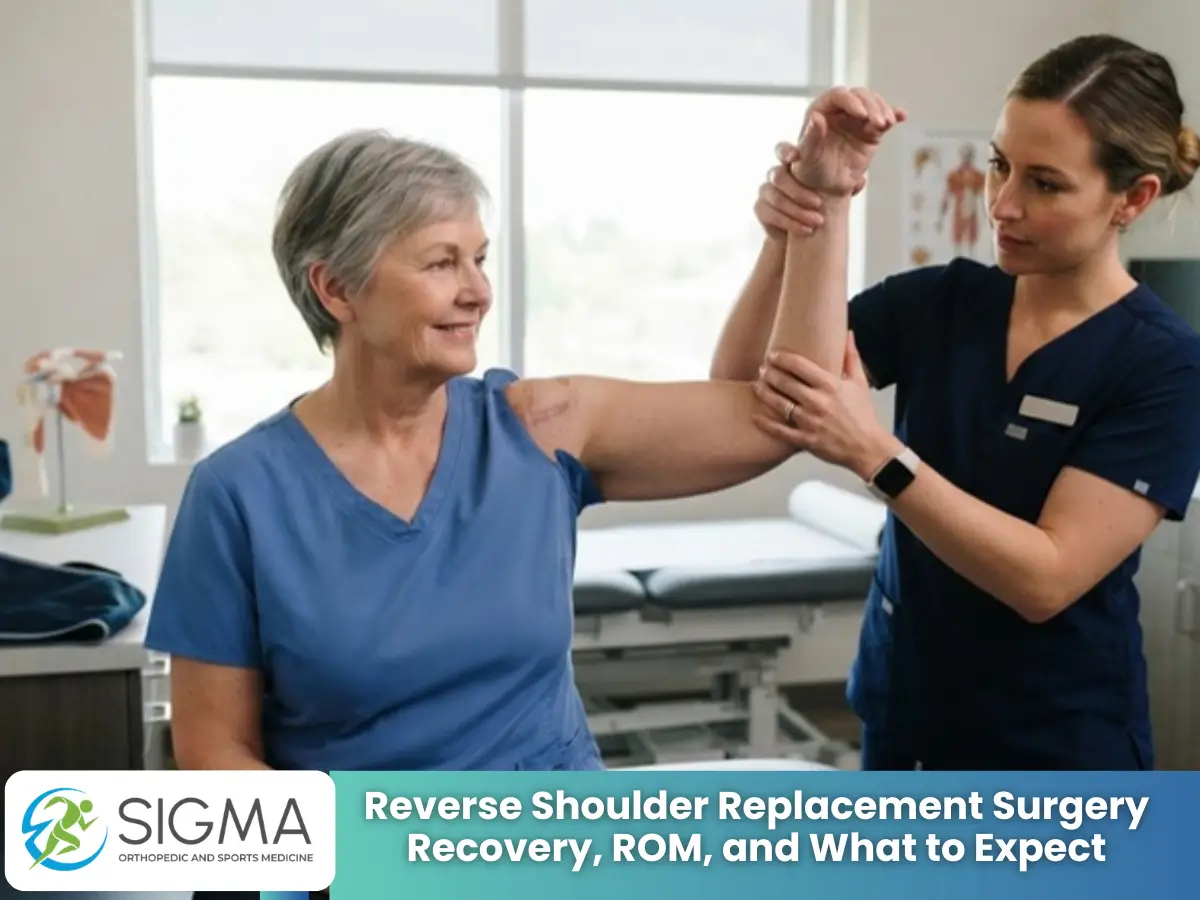
Reverse shoulder replacement can provide significant pain relief and improve the ability to use the arm for everyday activities, but it does not guarantee completely normal shoulder motion. Unlike a traditional shoulder replacement, the procedure changes the mechanics of the joint so the deltoid muscle can help compensate for a severely damaged or irreparable rotator cuff.
Range of motion usually improves gradually rather than immediately after surgery. Early recovery focuses on protecting the joint and allowing the surrounding tissues to heal. Physical therapy and carefully progressed exercises then help restore movement, strength, and function. Recovery commonly takes several months, and improvement may continue for six months to a year or longer.
What Is Reverse Shoulder Replacement Surgery?
Reverse shoulder replacement is a type of shoulder arthroplasty in which the normal positions of the ball and socket are switched. A metal ball is attached to the shoulder blade, while a socket-like component is placed on the upper arm bone. This design allows the deltoid muscle to provide more of the force needed to lift the arm when the rotator cuff is no longer functioning normally.
The procedure is often considered for people with severe shoulder arthritis combined with an irreparable rotator cuff tear, certain complex fractures, chronic shoulder dislocation, failed previous shoulder replacement, or other conditions that make a conventional replacement less suitable.
Why Is Reverse Shoulder Replacement Performed?
A traditional shoulder replacement depends substantially on a functioning rotator cuff. When the cuff is severely damaged, replacing the joint without addressing that problem may not restore useful movement. A reverse design changes the mechanics of the shoulder so the deltoid can take on a larger role.
That does not mean the new shoulder works exactly like a healthy shoulder. The goal is usually to reduce pain and restore practical function rather than recreate every movement a person had before the shoulder became damaged. Understanding that distinction is important when setting expectations for recovery and range of motion.
How Does a Reverse Shoulder Replacement Work?
The reversed implant changes the center and mechanics of the shoulder joint. Instead of relying primarily on the rotator cuff to keep the joint centered during elevation, the design allows the deltoid to help lift and position the arm.
This is one reason rehabilitation after the operation is carefully controlled. The implant and surrounding tissues need time to heal, while the deltoid and other muscles gradually adapt to their new mechanical role. Your surgeon determines when movement and strengthening can safely progress based on the procedure, fixation, tissue healing, and your individual risk factors.
What Is the Normal Range of Motion After Reverse Shoulder Replacement?
There is no single degree of movement that defines a “normal” result after reverse shoulder replacement. Many patients can regain useful elevation and perform everyday activities more easily, but the final range varies according to their condition before surgery, muscle function, implant factors, rehabilitation, and healing. The American Academy of Orthopaedic Surgeons notes that many patients can eventually raise the arm to around or somewhat above shoulder height, although completely overhead movement is not guaranteed.
The most useful way to judge recovery is therefore not a single ROM measurement. Pain relief, the ability to reach a shelf, dress, groom yourself, eat, and perform other daily tasks can be equally important.
What Range of Motion Can You Expect?
After uncomplicated surgery and rehabilitation, patients commonly work toward improved forward elevation and functional use of the arm. External rotation can also improve, although it may remain more limited in some people, particularly when the muscles responsible for that movement were badly damaged before surgery.
The amount of motion you achieve is highly individual. Someone who had relatively good movement before surgery may have a different result from someone who had years of stiffness, a massive rotator cuff tear, a fracture, or previous shoulder operations.
Research and clinical guidance support looking at shoulder function as a whole rather than expecting every patient to reach the same ROM target.
What Is Considered A Good ROM After Reverse Total Shoulder Replacement?
A good result is one that allows you to use the shoulder comfortably and safely for the activities that matter to you. For one patient, that may mean reaching a kitchen cabinet. For another, it may mean dressing independently, washing their hair, or returning to a preferred recreational activity.
This is why the normal ROM after reverse total shoulder replacement should not be treated as one universal number. The surgery is intended to restore useful mechanics to a damaged shoulder, not necessarily reproduce the complete movement of a healthy joint.
A surgeon or physical therapist can measure your motion and compare it with your preoperative function and recovery goals.
Range of Motion After Reverse Shoulder Replacement: What to Expect During Recovery

Recovery is progressive. Your shoulder may feel weak and stiff immediately after surgery, and movement can be intentionally restricted during the early healing period. Johns Hopkins Medicine explains that the timing of shoulder movement can vary depending on factors such as implant fixation and whether the procedure is a primary or revision replacement.
Over time, the emphasis generally shifts from protecting the repair to restoring mobility and then building strength. Your individual protocol may differ from someone else’s, so a published timeline should be viewed as a general framework rather than a prescription.
Early Recovery
During the first few weeks, protecting the surgical area is usually more important than trying to regain maximum movement. A sling may be used, and your surgeon or physical therapist may limit certain shoulder positions while tissues heal.
You may still be encouraged to move the hand, wrist, and elbow, along with other approved movements, to maintain mobility. The exact shoulder exercises allowed at this stage depend on your operation and surgeon’s protocol. MedlinePlus notes that sling use and restrictions can vary, and patients should follow their individual postoperative instructions closely.
Intermediate Recovery
As healing progresses, rehabilitation typically becomes more active. You may gradually work on lifting the arm, improving coordination, and using the shoulder during simple daily activities.
The goal is not to force the shoulder into a large range. Instead, movement is increased in a controlled manner while strength and stability develop. Some people notice meaningful functional improvement during this period, while others need more time because of age, previous surgery, muscle weakness, or the severity of the original shoulder problem.
Long-Term Recovery
Recovery does not necessarily end when formal therapy becomes less frequent. Cleveland Clinic reports that complete recovery commonly takes around six months, while other patients may continue making gains in strength and function beyond that point.
By the later stages of recovery, many patients are focused less on basic movement and more on functional strength and confidence using the arm. Your final result may continue to develop over many months. It is also possible to have some permanent limitations, particularly with demanding overhead or heavy activities.
What Factors Affect Your Recovery and Shoulder Movement?
Two people can undergo the same operation and have very different outcomes. The condition of the shoulder before surgery is one of the most important considerations. Johns Hopkins notes that the amount of movement recovered can depend partly on how much motion the patient had before surgery.
Other factors include whether the procedure is a primary or revision replacement, bone quality, implant fixation, muscle condition, rehabilitation, and the presence of other medical or orthopedic issues. This is why comparing your progress directly with another patient’s timeline can create unnecessary concern.
Your Shoulder Condition Before Surgery
A shoulder that has been painful and stiff for years may not regain the same movement as a shoulder that had relatively preserved mobility before surgery. Severe arthritis, an irreparable rotator cuff tear, fracture, chronic dislocation, or previous operations can all affect the starting point.
The condition of the surrounding muscles also matters. If muscles have been weakened or damaged for a long period, rehabilitation may need to focus on rebuilding functional strength as well as improving motion.
Rotator Cuff and Deltoid Function
The deltoid has an especially important role after a reverse replacement because the implant is designed to allow this muscle to help lift the arm when the rotator cuff is deficient.
This does not mean the deltoid works alone. Other muscles and tissues contribute to shoulder movement and stability. Your surgeon evaluates the condition of these structures before and after surgery to determine what type of rehabilitation is appropriate.
Rehabilitation and Healing
Rehabilitation can influence how efficiently you regain useful movement, but more therapy is not automatically better. Your program needs to match the stage of healing.
Current evidence continues to examine how early versus delayed rehabilitation affects outcomes. A recent systematic review found that earlier motion may improve early forward flexion after uncomplicated reverse shoulder replacement, while longer-term outcomes were broadly similar between early and delayed protocols.
What Exercises Are Done After Reverse Shoulder Replacement?
Postoperative rehabilitation is usually staged. Early exercises may focus on maintaining movement in areas that are not directly affected by the operation, while shoulder movement is introduced according to the surgeon’s restrictions. Later phases can involve active movement, coordination, and strengthening.
The exact exercises after shoulder surgery should never be copied from a general online list without considering your procedure. The Royal National Orthopaedic Hospital specifically advises patients not to begin certain exercises until they have been guided by their therapist.
Early Post-Operative Shoulder Exercises
Early rehabilitation may include gentle hand, wrist, and elbow movements, along with carefully selected shoulder exercises when permitted. These activities help maintain mobility while the shoulder heals.
Some rehabilitation programs use assisted movements, meaning the operated arm receives help from the opposite arm or another method rather than generating full movement independently. The purpose is controlled mobility, not aggressive stretching.
Your own postoperative plan takes priority because restrictions can vary according to surgical findings, implant fixation, tissue healing, and individual risk.
Exercises as Your Shoulder Heals
As healing progresses, therapy can gradually introduce more active shoulder movement. The focus may shift toward improving the ability to raise the arm, control movement, and use the shoulder during normal activities.
This is where consistent rehabilitation becomes important. The objective is to build usable movement without overwhelming healing tissues. If an exercise causes significant or persistent pain, your therapist should know so the activity, technique, or progression can be reassessed.
Strengthening During Later Recovery
Strengthening is generally introduced after sufficient healing and when your surgeon or therapist believes the shoulder is ready. Exercises may target the deltoid and other muscles that contribute to shoulder control and functional movement.
The timing is important. MedlinePlus notes that strengthening exercises may not begin until substantially later in the recovery process, depending on the patient’s individual plan.
What Activities Can You Do After Reverse Shoulder Replacement?
The purpose of rehabilitation is ultimately to help you use your arm in real life. As healing progresses, many people gradually return to everyday activities such as eating, dressing, grooming, light household tasks, and reaching comfortable levels.
However, returning to activity is not the same as returning to unrestricted use. Cleveland Clinic notes that heavy lifting, sports, and intense physical activity may need to be avoided for a period of time before activity is gradually increased with the surgeon’s approval.
Everyday Activities
Daily activities are usually reintroduced progressively. Early on, you may need assistance with tasks that require reaching, lifting, or using the operated arm away from your body.
As strength and control improve, simple tasks become easier. Your therapist can help you modify activities while protecting the shoulder and gradually restore independence.
Returning to Work and Driving
The timing of returning to work depends heavily on what your job requires. A desk-based role may be possible sooner than work involving lifting, pushing, pulling, climbing, or repetitive overhead activity.
Driving also requires more than simply being able to move the shoulder. You need adequate control, comfort, reaction ability, and freedom from medications that impair driving. Your surgeon should determine when returning to the road is appropriate.
Exercise and Sports
Some patients return to recreational activities after recovery, but the level of activity should be individualized. Low-impact activities may be more compatible with a shoulder replacement than activities involving falls, collisions, heavy loads, or repeated high-force overhead movements.
The safest approach is to discuss your specific sport or exercise routine with your orthopedic team rather than assuming it is automatically safe.
What Are the Limitations After Reverse Shoulder Replacement?
A reverse shoulder replacement can significantly improve function, but it should not be viewed as a way to create a completely normal shoulder. Because the operation is often performed when the rotator cuff is severely damaged, certain movements and strength demands may remain limited.
The American Academy of Orthopaedic Surgeons explains that many patients can lift the arm to around shoulder height or somewhat above it after rehabilitation, but full overhead function is not guaranteed.
Heavy Lifting and Overhead Activities
Heavy lifting can place substantial stress on the replacement and surrounding structures. Your surgeon may recommend permanent or long-term limits depending on your individual situation.
Overhead work may also remain difficult, especially if it requires repetitive or forceful movement. The goal is to preserve the function of the replacement while allowing you to remain active within safe limits.
Why Full Normal Shoulder Motion May Not Return
The implant changes the mechanics of the shoulder, but it does not recreate every structure that was damaged before surgery. If the rotator cuff was irreparable, the replacement cannot simply restore those tendons to their original condition.
As a result, a successful outcome can still involve less motion or strength than a healthy shoulder. That does not necessarily mean the surgery failed. Pain reduction and improved everyday function are important measures of success.
What If You Have Limited ROM After Reverse Shoulder Replacement?
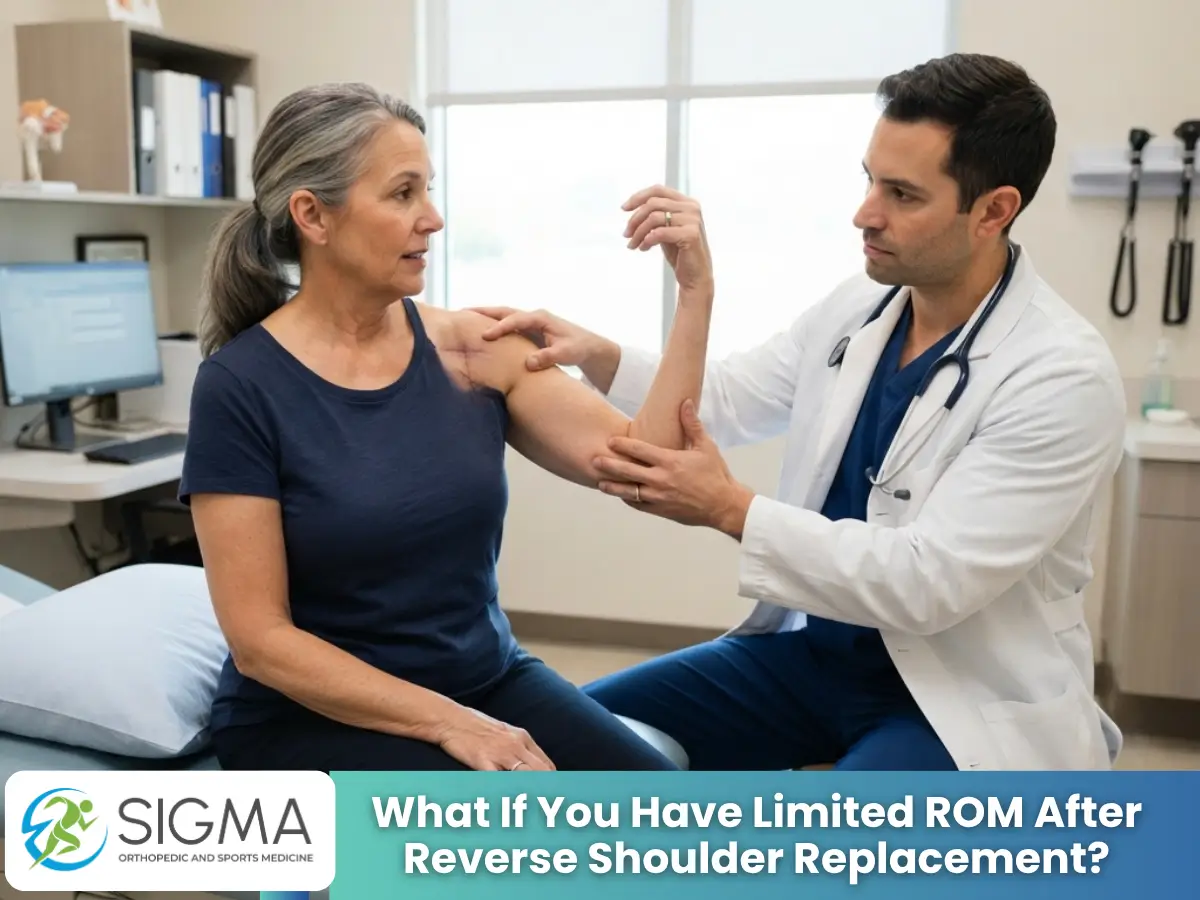
Some stiffness is expected during recovery, especially early on. However, recovery should be monitored over time rather than judged by how the shoulder feels on a single day.
If movement seems to stop improving, pain begins increasing instead of decreasing, or you experience a sudden change in shoulder function, contact your orthopedic team. A clinician can determine whether the issue reflects normal recovery, rehabilitation needs, or a complication requiring further evaluation.
When Stiffness Is Part of Normal Recovery
Early stiffness does not automatically mean something is wrong. The shoulder has undergone major surgery, and the surrounding tissues need time to heal.
Progress can also be uneven. You may notice periods when movement improves quickly followed by periods of slower change. Your physical therapist can assess your motion and determine whether your rehabilitation should continue as planned or be adjusted.
When Limited Movement May Need Further Evaluation
Persistent or worsening limitations deserve attention when they do not fit your expected recovery pattern. Your surgeon may assess strength, joint stability, pain, and movement and may order imaging if necessary.
Do not try to solve unexplained stiffness by aggressively stretching or strengthening the shoulder on your own. The appropriate response depends on why the movement is limited.
When to Contact Your Orthopedic Surgeon
Contact your surgical team if you develop increasing pain, significant swelling, redness, drainage, fever, chills, a sudden loss of function, or symptoms following a new injury. These symptoms do not necessarily mean a serious complication has occurred, but they warrant professional assessment. Johns Hopkins specifically advises patients to notify their doctor about continued swelling or bleeding and symptoms such as fever or chills.
How Can You Get the Best Possible Outcome?
A good recovery is usually built through gradual progression rather than trying to regain normal movement as quickly as possible. Your surgeon’s restrictions should take priority over generic exercise schedules found online because rehabilitation depends on the details of your operation.
Keeping follow-up appointments is also important. Your orthopedic team can monitor healing, evaluate your movement, adjust rehabilitation, and address problems before they become more difficult to manage.
Follow Your Personalized Rehabilitation Plan
Your physical therapist can show you how to perform each movement correctly and when to progress. This is particularly important after a reverse replacement because certain positions may be restricted during early healing.
Progress Gradually
Improvement should be measured over weeks and months rather than day to day. Increasing exercise intensity simply because you want faster ROM can expose healing tissues to unnecessary stress.
Focus on Function, Not Just Degrees of Motion
A ROM measurement is useful, but it is only part of the picture. Being able to reach your head, dress independently, prepare food, perform household tasks, or enjoy appropriate recreation may be more meaningful than achieving a specific number on a goniometer.
Reverse Shoulder Replacement: What Should You Realistically Expect?
The most realistic expectation is that reverse shoulder replacement can provide substantial pain relief and improve useful arm function, but the shoulder may not return to completely normal movement. Recovery is gradual, and the final result depends heavily on the condition of the shoulder before surgery, the quality of healing, muscle function, rehabilitation, and the specific surgical situation.
Rather than asking whether you will regain the exact ROM of a healthy shoulder, a better question is whether your shoulder will become more comfortable and functional for the activities that matter to you.
For patients considering surgery or navigating recovery, SIGMA Orthopedics and Sports Medicine emphasizes patient-centered orthopedic care and individualized treatment planning rather than assuming every shoulder follows the same recovery path.
Conclusion
Reverse shoulder replacement is designed to solve a specific mechanical problem and restore useful function when conventional shoulder replacement may not be appropriate. The expected range of motion is therefore different from that of a healthy shoulder, and there is no single ROM number that guarantees a successful result.
The best outcomes come from realistic expectations, appropriate protection during early healing, individualized rehabilitation, and gradual progression toward functional activities. If you are considering reverse shoulder replacement or have questions about your recovery, an orthopedic evaluation can help determine what range of motion and activity level are realistic for your particular shoulder.
At SIGMA Orthopedics and Sports Medicine, individualized evaluation can help patients understand their treatment options, recovery expectations, and the steps involved in returning to comfortable, functional shoulder use.
FAQs
What is the normal range of motion after reverse shoulder replacement?
There is no single ROM value that is normal for every patient. Many people regain useful forward elevation and enough movement for everyday activities, but the final range depends on preoperative motion, muscle condition, diagnosis, rehabilitation, and healing.
How long does it take to regain ROM after reverse shoulder replacement?
Recovery generally takes several months. Cleveland Clinic describes complete recovery as commonly taking around six months, while some patients continue improving in strength and function for longer.
Will I have full range of motion after reverse shoulder replacement?
Not necessarily. The procedure is designed primarily to relieve pain and restore useful function, especially when the rotator cuff is severely damaged. Some patients retain limitations in overhead motion, rotation, strength, or other movements.
What is a good ROM after reverse total shoulder replacement?
A good ROM is one that allows you to perform important daily activities comfortably and safely. Your surgeon or physical therapist can determine whether your movement is progressing appropriately for your specific circumstances.
Can you raise your arm normally after reverse shoulder replacement?
Many patients can raise the arm to around shoulder height or somewhat above it after rehabilitation. However, completely normal overhead movement is not guaranteed.
What exercises should you do after reverse shoulder replacement?
Exercises should be selected and progressed by your surgeon or physical therapist. Early rehabilitation may involve gentle assisted movement and hand, wrist, and elbow exercises, followed later by active movement and strengthening.
What activities should you avoid after reverse shoulder replacement?
Your restrictions depend on your surgery and recovery. Heavy lifting, high-impact activities, repetitive overhead loading, and movements that place excessive stress on the replacement may be limited. Follow your surgeon’s specific recommendations.
Can range of motion improve after six months?
Yes. Although improvement may become slower over time, some patients continue gaining strength, coordination, and functional movement beyond six months. Recovery can continue toward a year or longer depending on the individual.
Disclaimer: This content is for informational purposes only and does not constitute medical advice. Always seek the advice of a qualified healthcare provider with any questions you may have regarding a medical condition or before starting any new medication. Never disregard professional medical advice or delay in seeking it because of something you have read in this blog.